
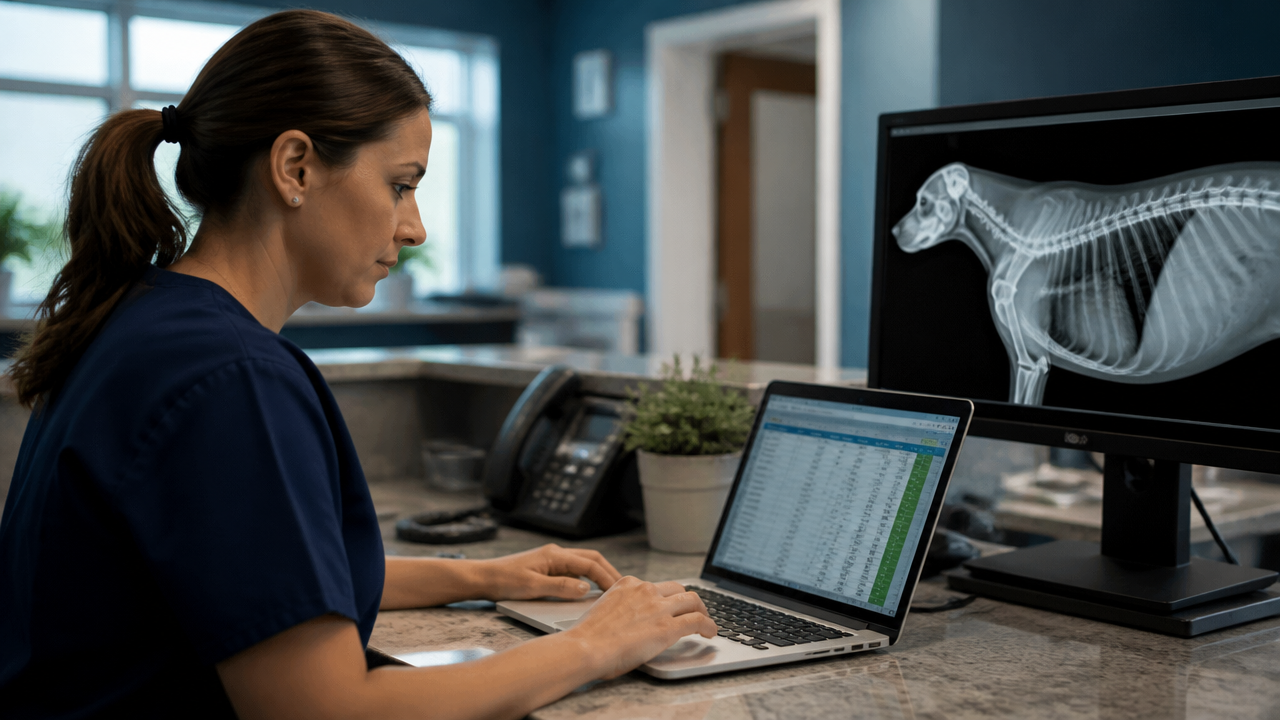
Teleradiology pricing is one of those numbers that nobody publishes and everybody wants before the first call. This guide sets out what US practices actually pay for veterinary radiology reads, what moves the price, which fees tend to be left out of the quote, and how to check in an afternoon whether outsourcing your imaging pays for itself.
Key takeaways
- Reading fees are quoted per study and vary most by modality, not by provider.
- STAT turnaround is a surcharge on availability, so reserve it for decisions waiting in the building.
- Contracts and monthly minimums are avoidable. Pay per study while you evaluate report quality.
- Ask for a per modality rate card in writing, including recheck, addendum and consult fees.
- The comparison that matters is the read fee against the cost of one missed or delayed finding.
The short answer on veterinary teleradiology cost
Veterinary teleradiology is priced per study. Routine radiographic interpretation sits at the low end, ultrasound and fluoroscopy in the middle, and CT and MRI at the top because a cross sectional study is hundreds of images rather than three. Every provider will quote a different number, but the shape of the pricing is the same everywhere, and the shape is what you should be comparing.
| Study type | Relative reading fee | Why |
|---|---|---|
| Radiographs, 2 to 3 views | Baseline | Short read, well defined search pattern |
| Radiographs with prior comparison | Baseline or small uplift | Comparison work adds reading time |
| Ultrasound study review | Above baseline | Cine loops and operator dependent images |
| CT | Several times baseline | Hundreds of slices, multiplanar review, longer report |
| MRI | Highest | Multiple sequences, neurological detail, longest read |
| STAT, any modality | Surcharge on the above | Immediate queue priority and staffed out of hours cover |
What drives the price of a read
- Modality and study size. The single largest factor. Reading time scales with image count and anatomical complexity.
- Turnaround. One hour STAT costs more than 24 hour routine, because it requires coverage rather than effort.
- Volume. Higher monthly study counts usually attract better rates, though not always tied to a minimum commitment.
- Report depth. A named radiologist, ranked differentials, stated limitations and a specific next step cost more to produce than a template.
- Access to the radiologist. Providers who let you call the person who read your case are pricing in specialist time, and it is usually the cheapest part of the relationship to use.
The three pricing models you will be quoted
- Pay per study, no contract. You pay for what you send. Best while you are evaluating a provider, and best for practices with uneven caseload.
- Monthly minimum or bundle. A lower per study rate in exchange for committed volume. Works only if your quietest month still clears the minimum, otherwise you are paying for reads you never used.
- Subscription or per seat. A flat platform fee, sometimes with reads charged on top. Check carefully what the fee covers, because platform access is not the same thing as interpretation.
Free for veterinary teams
The teleradiology cost comparison worksheet
A one page sheet for comparing quotes side by side: per modality rates, surcharges, the fees providers tend to leave out, and a simple break even calculation for your own study volume. Ask and we will send it.
- A rate card template to send to every provider you are considering
- The eight fees to ask about explicitly before signing anything
- A break even calculator for reads against missed and delayed findings
No contracts. No minimums. Radiologists on shift every day of the year.
Fees that only show up on the invoice
The quoted per study rate is rarely the whole invoice. Ask about each of these in writing before you send your first case.
| Fee | What to ask |
|---|---|
| STAT surcharge | How much, and what turnaround does it guarantee |
| Additional views or body parts | Is a thorax and abdomen one study or two |
| Addendum or report revision | Charged or included, and in what timeframe |
| Consult call with the radiologist | Included, per minute, or by arrangement |
| Recheck and prior comparison | Same rate as a new study, or reduced |
| Platform, PACS or onboarding | One off, monthly, or none |
| Minimum monthly spend | Exists at all, and what happens if you miss it |
| Cancellation | Notice period and any exit fee |
What practices charge clients for imaging
Most practices do not itemise the reading fee. It is folded into the imaging charge, and the conversation with the owner is about what the images will tell you rather than about who reads them. Where specialist interpretation is mentioned, it usually helps: a client who understands that a board-certified radiologist reviewed their dog's chest is being told the practice took the case seriously, not that the practice needed help.
Working out whether a read pays for itself
Do this with your own numbers rather than a provider's case study. Take a month of imaging and total the reading fees you would have paid. Then set that figure against what the month actually contained:
- Studies you repeated because the first attempt did not answer the question.
- Cases you referred where a report might have kept the work in house.
- Patients held overnight while a decision waited on someone's opinion.
- Hours of your own time spent second guessing an image at the end of a shift.
- Any finding that was picked up later than it should have been.
For most practices the reading fees are the smaller number, and the interesting part of the exercise is not the arithmetic but what the list reveals about where time is going. The related read on this is our piece on how teleradiology changes the clinic floor.
Questions to ask before you accept a quote
- What is the rate for each modality I actually use, in writing?
- What is the STAT surcharge, and what turnaround does it guarantee?
- Is there a contract, a minimum, or a notice period?
- Are addenda, revisions and radiologist phone calls included?
- Is a thorax and abdomen billed as one study or two?
- Who reads overnight, and are they named on the report?
- What percentage of studies in the last 30 days met the promised turnaround?
Price is the easy part of the comparison and the least decisive. Before you sign anything, run the quality checks in our guide to turnaround versus accuracy and read the getting started guide to outsourcing. If you would rather just see our numbers, ask us for a rate card. No contracts, no minimums.
Frequently asked questions
Work with us
Board-certified reads, 1 hour STAT, every day of the year
No contracts, no minimums, and direct access to the radiologist reading your case.